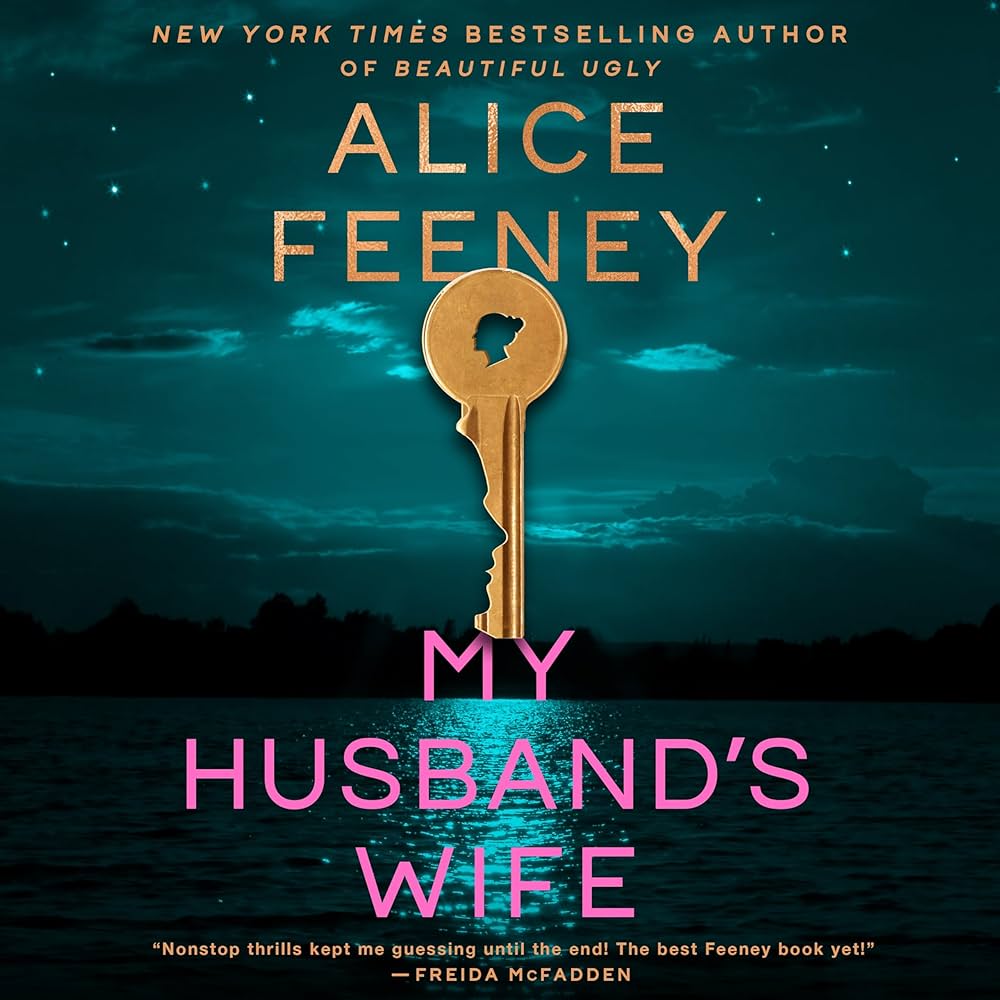
My Husband’s Wife – Alice Feeney
Eden Fox, an artist on the brink of her big break, sets off for a run before her first exhibition. When she returns to the home she recently moved into, Spyglass, an enchanting old house in Hope Falls, nothing is as it should be. Her key doesn’t fit. A woman, eerily similar to her, answers the door. And her husband insists that the stranger is his wife.
One house. One husband. Two women. Someone is lying.
Six months earlier, a reclusive Londoner called Birdy, reeling from a life-changing diagnosis, inherits Spyglass. This unexpected gift from a long-lost grandmother brings her to the pretty seaside village of Hope Falls. But then Birdy stumbles upon a shadowy London clinic that claims to be able to predict a person’s date of death, including her own. Secrets start to unravel, and as the line between truth and lies blurs, Birdy feels compelled to right some old wrongs.
Review
There’s something especially frustrating about a thriller that almost works, like a loved door you can see through, but the key just doesn’t turn.
My Husband’s Wife leans heavily on the promise of an unreliable narrator, but here, that dissolves into something far less satisfying: not unreliability, but convenience. Not perception warped by trauma or bias, but a narrator who withholds, bends, or outright contradicts reality simply because the plot needs her to.
The magic of an unreliable narrator—when it does work, like in The Girl on the Train—comes from a fragile contract with the reader. You’re misled, yes, but fairly so. The cracks are there if you look closely. In this novel, though, the misdirection feels imposed rather than earned, as if the narrative is less a mind unraveling and more a puppet being tugged toward a twist.
Then there’s Birdy.
She is a character that feels hyper-aware of herself—steeped in that very specific millennial-coded tone that tries to be sharp and self-aware but ends up feeling strangely artificial and annoying. Instead of grounding the story, her characterization floats just above it. There’s a persistent “not like other girls” energy woven into her. You don’t quite root for her; you observe her, at a distance, like someone performing relatability rather than actually being it.
And oh, the dialogue.
Lines like “Charge him rent for the time he lives in my head” don’t land as clever, they land as curated. As if they were written for a screenshot. It’s the kind of phrasing that feels like TikTok jarg.
This is a book that wants to be twisty, but in chasing those expectations, it forgets to build the emotional and narrative structure that makes a book a good one. The result is a story that feels engineered for tv, with very obvious “wanted to be adapted” writing.
A thriller should feel like a slow tightening, like something closing in around you. This one feels more like a series of doors slamming shut behind you, each one a little too deliberate, a little too loud.
This books somehow made Beautiful Ugly look like a not so ugly book in comparison.

Click for spoilers!
It is eventually revealed that Birdy was Harrison Woolf’s first wife. Ten years prior to the main events, they had a daughter named Gabriella. At that time, Eden Fox was their nanny. Birdy, then a high-ranking detective, believed she had accidentally hit her daughter with her car during a rainstorm. However, the truth was much more sinister: Eden Fox had been having an affair with Harrison and was caught by eight-year-old Gabriella. To silence the child, Eden pushed Gabriella over a banister, then moved her unconscious body into the street and staged it to look like a hit-and-run.
After receiving a terminal cancer diagnosis and discovering the truth from a now-recovered (though mute) Gabriella at a care facility called The Manor, Birdy, Harrison, and a woman named Mary Kendall (a carer) conspired to destroy Eden.
They moved Eden to the remote village of Hope Falls and began gaslighting her. While Eden was out for a run, they changed the locks, removed all traces of her from the house, and Mary stepped into Eden’s life, pretending to be her at her own art exhibition, with the help of Harrison.
Although Birdy, Harrison, and Mary planned for Eden to die, none of them actually killed her. ane Carter, the wife of Sergeant Luke Carter, was the murderer. Jane had discovered that the real Eden Fox was having an affair with her husband.
Birdy had been told by Harrison’s company, Thanatos (which uses AI to predict death dates), that she would die on November 2, 2025. On that night, she attempted suicide by taking a cocktail of pills. However, Luke Carter found her and performed CPR, saving her life. Birdy is in remission and goes onto live at Spyglass with her daughter, Gabriella,

2 / 5.



 Flowers Escaping
Leave a comment